Return to sport: four phases back to full training
After an injury, it isn't the calendar that decides when you can train flat out again – it's what your body can handle. Here's what a structured way back looks like.
 Patrick Physiotherapist & Fitness Coach
Published on
5 min read
An injury knocks you out of your rhythm. The impatience is understandable: you want to get back, and fast. That’s exactly where setbacks happen – often not because people do too much, but because they do the wrong things too early.
So return to sport isn’t a date. It’s a process. That’s also the view of the international consensus statement published in 2016 after the First World Congress in Sports Physical Therapy in Bern: returning to sport isn’t a single decision at the end of rehab, but a continuum that runs alongside it.
In short
- Return to sport is a continuum, not a deadline.
- Four phases build on each other: settle things down, rebuild basic strength, develop capacity, return to sport-specific demands.
- You move on when you meet the criteria, not when the calendar says so.
- How you feel the next morning is a good guide to whether the dose was right.
- Your head has to come along too: confidence and low fear go hand in hand with a successful return.
Three stages back
The Bern consensus describes the way back in three stages:
- Return to participation: you’re training again, but below your pre-injury level.
- Return to sport: you’re back in your sport, but not yet at the level you want.
- Return to performance: you’re back at your level – or above it.
Ideally, the decision on when to move forward is made together: by you, your doctor, your physiotherapist and your coach. The authors are candid that research on specific return criteria is still thin. That makes a clear, traceable plan all the more important.
At the club, we translate this continuum into four training phases. Each one has a goal, and we only move on once it’s been reached.
Good to know: This article doesn’t replace a medical examination. With acute pain, swelling or after surgery, always see a doctor first. Your training then follows whatever your doctor has cleared.
Phase 1: Settle and protect
The first job is to let the tissue settle. Complete rest is rarely the goal. Current guidance for soft-tissue injuries – such as the PEACE & LOVE approach from Dubois and Esculier (2020) – recommends a short period of protection lasting a few days, followed by gradually reintroducing load as the tissue tolerates it.
What matters in this phase:
- keep pain-free movement in the neighbouring joints
- keep training the parts of your body that aren’t injured
- shape sleep, nutrition and daily life so that recovery can happen
- take any questions about medication to your doctor
You’re ready to move on when everyday symptoms are easing, the injured area moves largely without pain and any swelling has clearly gone down.
Phase 2: Mobility and basic strength
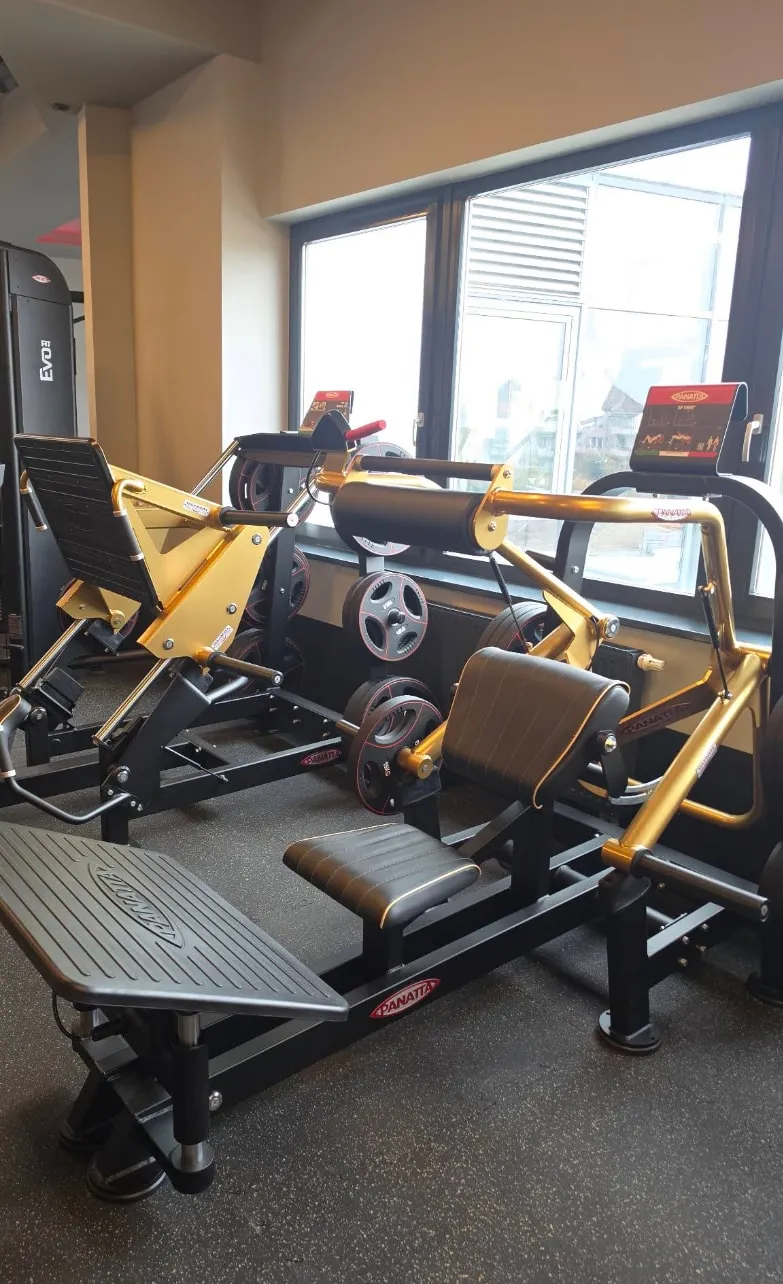
Now the aim is to win back full range of motion and rebuild the muscles around the injured structure – slowly and with control. Guided movements on the cable stations and selectorized machines work well here because the load can be dosed precisely. Add to that holds, where the muscle works under tension without the joint having to cope with much movement.
The key rule: quality before load. In this phase, one clean rep with a light weight is worth more than any heavy one.
You’re ready to move on when your range of motion is largely restored and basic exercises feel clean, without pain building up.
Phase 3: Build capacity
The third phase brings back what your sport is made of: complex movements, heavier loads, more volume. Squats, lunges, pulling and pressing – adapted to your injury and your sport. At the club, physiotherapist Patrick and athletic performance coach Cedric work hand in hand here, so the transition into performance training is seamless.
Only one lever goes up at a time: weight, reps or speed. That way, it stays clear how your body is responding to the new load.
Pain as a guide
One tool from tendon rehab is the pain-monitoring model. In a randomised trial in people with Achilles tendon problems (Silbernagel et al., 2007), participants were allowed to keep running and jumping using this model – within clear limits: pain during and immediately after activity could reach no more than 5 out of 10, and it should be back to its starting level by the next morning. The researchers found no disadvantage compared with the group that paused these activities.
In practice, we use the principle as a guide: if pain and swelling are stable or better the day after training, the dose was right. If they’re clearly worse, it was too much – and the plan gets adjusted. One caveat: the model comes from tendon rehabilitation. After fractures or surgery, your doctor’s instructions apply.
Phase 4: Back to your sport
The final phase prepares you for the real demands of your sport: sprints, changes of direction, jumps, contact. Only once these work reliably under controlled conditions do you go back to team training, and then to competition.
Typical criteria for that step:
- full, pain-free range of motion
- strength that has come close to the uninjured side
- clean technique in sport-specific movements – even when tired
- the confidence to perform the movement without hesitating
A cohort study after ACL reconstruction (Grindem et al., 2016) shows how much this can matter: people who returned to sport no earlier than nine months after surgery, and with more symmetrical thigh strength beforehand, re-injured their knee considerably less often. That applies to this particular injury. But it shows that time and measurable criteria belong together – a good feeling alone isn’t enough.
Your head has to come along
That last criterion is often underestimated. A systematic review (Ardern et al., 2013) found that motivation, confidence and low fear were associated with a greater likelihood of returning to the pre-injury level – and of getting there faster. Fear of re-injury was a common response on returning. That’s why rebuilding confidence step by step is a fixed part of the plan.
Capacity doesn’t come from protecting yourself. It comes from the right dose at the right time.
Why structure makes the difference
A common mistake is skipping phase 3: the pain has gone, so it’s straight back to the pitch. But pain-free doesn’t mean ready for load. A structured build-up gives you confidence that your body can genuinely handle what’s coming.
At the club, we guide you through all four phases – with a physiotherapist’s eye, clean technique and a plan that follows your progress, not the calendar. If you’re on your way back from an injury, talk to us at your trial session. We’ll work out together where you stand and what the sensible next step is.
Sources
- Ardern CL et al. (2016). 2016 consensus statement on return to sport from the First World Congress in Sports Physical Therapy, Bern. British Journal of Sports Medicine, 50(14), 853–864. doi:10.1136/bjsports-2016-096278
- Dubois B, Esculier JF (2020). Soft-tissue injuries simply need PEACE and LOVE. British Journal of Sports Medicine, 54(2), 72–73. doi:10.1136/bjsports-2019-101253
- Silbernagel KG, Thomeé R, Eriksson BI, Karlsson J (2007). Continued sports activity, using a pain-monitoring model, during rehabilitation in patients with Achilles tendinopathy: a randomized controlled study. American Journal of Sports Medicine, 35(6), 897–906. doi:10.1177/0363546506298279
- Grindem H et al. (2016). Simple decision rules can reduce reinjury risk by 84% after ACL reconstruction: the Delaware-Oslo ACL cohort study. British Journal of Sports Medicine, 50(13), 804–808. doi:10.1136/bjsports-2016-096031
- Ardern CL, Taylor NF, Feller JA, Webster KE (2013). A systematic review of the psychological factors associated with returning to sport following injury. British Journal of Sports Medicine, 47(17), 1120–1126. doi:10.1136/bjsports-2012-091203
This article is for general information only and does not replace medical advice.